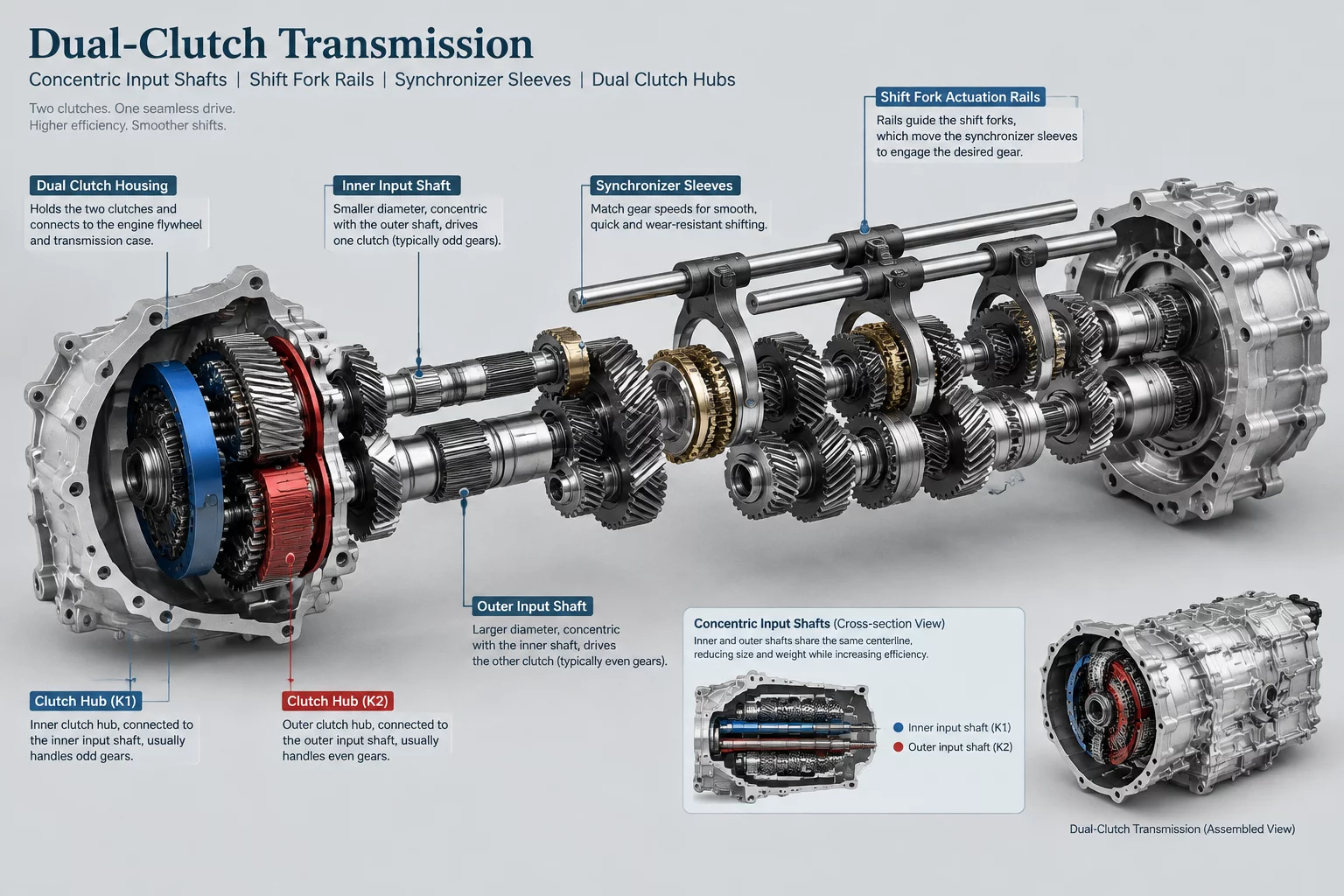
Dual-Clutch Transmission Mechanical Linkage Map
Dual-Clutch Architecture Overview
Dual-clutch transmissions (DCT) deliver instantaneous gear shifts without interrupting torque delivery to the drive wheels. The assembly uses two concentric input shafts—one operating odd gears and the other operating even gears—coupled to dual multi-plate wet or dry clutches. Electro-hydraulic or electromechanical shift actuators move shift forks along selector rails to pre-select upcoming gear ratios. Mapping these mechanical linkages illustrates how precise timing and mechanical clearance prevent gear lockout and unwanted clutch drag.
Primary Mechanical Interfaces in DCT Units
Fast shift speeds require lightweight selector components operating inside rigid transmission housings with tight mechanical fits.
Concentric Inner and Outer Input Shafts
The outer hollow shaft rotates freely around the solid inner shaft on needle roller bearings. High rotational speed differences occur when one shaft drives the vehicle while the other remains idle during pre-selection phases. Oil feed channels within the shafts supply continuous lubrication to these internal needle bearing races.
Shift Fork Roller Guides and Selector Sleeve Channels
Shift forks feature hardened bronze or low-friction polymer pads that ride inside grooves on sliding synchronizer sleeves. Electromechanical linear actuators push the fork rail, moving the selector sleeve to align synchronizer teeth with target gear dogs. Linear ball bushings on selector rails minimize sliding friction during millisecond shift cycles.
Dual-Mass Flywheel and Clutch Hub Splines
Engine torque enters the transmission through a dual-mass flywheel connected to the outer clutch housing. In-line internal splines hub to the twin clutch assemblies. Torsional damper springs within the flywheel isolate high-frequency crankshaft angular velocity fluctuations before torque reaches the clutch friction plates.
Dynamic Linkage Behaviors and Pre-Selection Mechanics
Executing smooth ratio changes demands coordinated movement between shifting forks and hydraulic clutch pistons.
- Synchronizer Cone Interfaces: Friction rings equalize rotational speed between free-wheeling gears and input shafts prior to mechanical dog engagement.
- Detent Ball Mechanisms: Spring-loaded steel detents hold selector rails securely in neutral or engaged positions, preventing gear pop-out under acceleration forces.
- Interlock Pin Assembly: Mechanical interlock pins prevent selector movement into two gear ratios on the same sub-shaft simultaneously, protecting components from destruction.
- Actuator Rod Seals: Quad-ring pressure seals prevent pressurized hydraulic fluid from bleeding from actuator cylinders into the transmission oil sump.
Core Mechanical Specifications
Optimal shift performance demands minimal deflection and tightly controlled tolerances across all shifting linkages.
- Shift Execution Time: Mechanical engagement completed within 30 to 50 milliseconds per shift cycle.
- Fork Axial Deflection: Restricted under 0.05 mm under peak actuator engagement force of 2,500 N.
- Concentric Shaft Runout: Total indicator reading (TIR) held under 0.008 mm along the entire shaft assembly length.
- Synchronizer Friction Coefficient: Maintained between 0.10 and 0.12 across dynamic temperature ranges.
Maintenance Diagnostics and Interface Analysis
Mapping selector linkages and clutch interfaces accelerates root-cause failure analysis for transmission slipping or rough gear engagement. Excessive wear on shift fork guide pads often indicates actuator misalignment or hydraulic pressure drops within selector cylinders. By auditing tolerance stacks across the entire linkage map, engineers can refine shift algorithms and improve transmission durability under aggressive driving cycles.
Structured Reference Data for Mechanical Component Connections
Our contacts
Any questions? Contact us
Subscribe to Receive Updated Guides on Component Interactions
Sign up to our newsletter to receive the latest news.